REWARD
A game your dog enjoys
If your dog enjoys the game, offer it as a reward for getting a training task right.


WUFTREK GUIDE · TRAINING AND PLAY
Choose a training toy to suit your dog’s play style, size and grip. Compare TrekZilla, TrekMaster and MegaBite for interactive reward sessions.
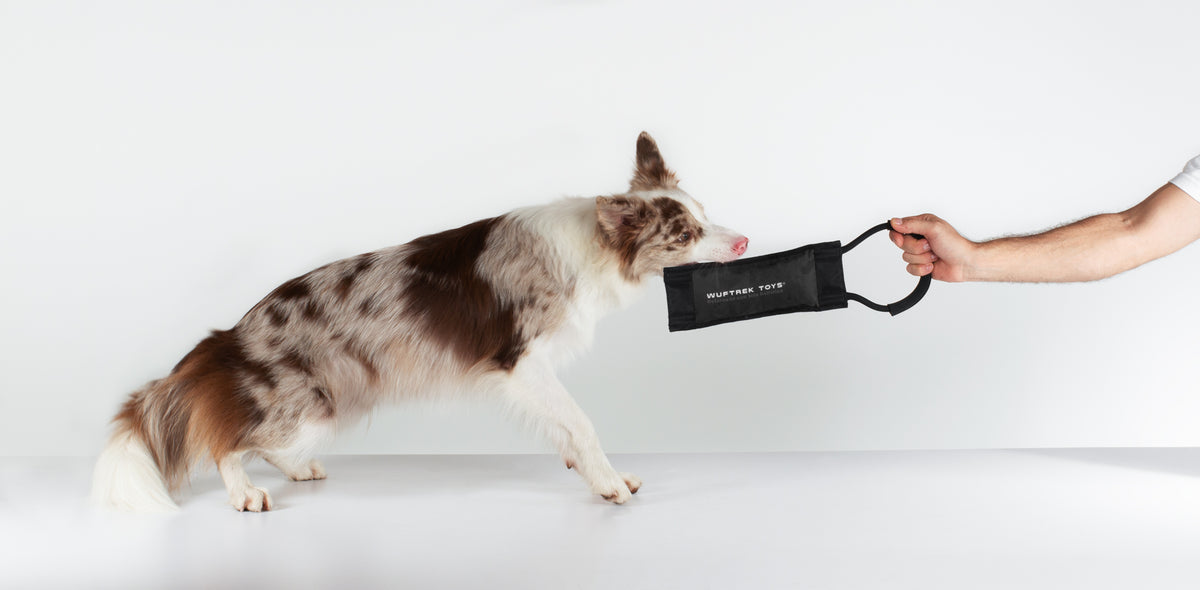
PLAY WITH A PURPOSE
Within the broader dog toy category, training toys are intended for shared activities. This guide focuses on handled designs for tug play and rewards, a useful choice when your dog enjoys playing with you.
REWARD
If your dog enjoys the game, offer it as a reward for getting a training task right.
INTERACTION
You hold the handle while your dog grips the toy body. Choose a comfortable handle and keep your hands clear of the biting area.
CHOICE
An elongated body, two handles or an unstuffed design give you different ways to hold the toy. Compare them against your dog’s needs and how you want to play.
THE WUFTREK RANGE
All three models are for supervised interactive play. Their differences lie in shape, handles and construction, rather than a promise to be indestructible.

NEOPRENE-COVERED HANDLE
An elongated 48 × 8 cm toy for interactive training. It combines an aramid-reinforced body with a static nylon rope handle covered in neoprene.
Choose it if you want an elongated format and a handle for guiding play. Check that its dimensions suit your dog’s mouth.
Explore TrekZilla →
TWO NYLON HANDLES
A toy with two soft nylon webbing handles, a polyester exterior, internal aramid reinforcement and siliconized cotton filling.
Choose it if you prefer two grip points for holding the toy during tug play and a filled body.
Explore TrekMaster →
FLEXIBLE, UNSTUFFED BODY
A compact, flexible, unstuffed format with a polyester exterior, internal aramid reinforcement and a neoprene-covered handle.
Choose it if you prefer an unstuffed body and a neoprene-covered handle for interactive reward sessions.
Explore MegaBite →| Model | Handler grip | Toy body |
|---|---|---|
| TrekZilla | Static nylon rope with neoprene | Elongated 48 × 8 cm body |
| TrekMaster | Two nylon webbing handles | Siliconized cotton filling |
| MegaBite | Neoprene-covered handle | Compact, flexible and unstuffed |
BEFORE YOU CHOOSE
The right training toy fits your dog’s mouth, your grip and the activity. Always confirm the specifications of each model.
Check the product’s dimensions. The body should be comfortable for your dog to grip, without being small enough to swallow or become lodged.
Consider which feels more natural: a neoprene-covered handle or two nylon handles. Handles are for your hands, not for your dog to chew.
Observe whether your dog grips the body and plays with you or tries to tear it apart. Intensity and usage matter as well as size; do not choose by breed or weight alone.
TrekMaster is filled and MegaBite is unstuffed. Compare the feel and format you prefer, while remembering that both need inspection and supervision.
DESIGN AND MATERIALS
Consider the whole design: body, handles, reinforcement and seams. Material information helps you compare designs and understand what to inspect over time.
INTERNAL REINFORCEMENT
TrekZilla, TrekMaster and MegaBite include aramid reinforcement. A reinforced body does not make a toy immune to wear.
BODY
TrekMaster and MegaBite use a polyester exterior. Inspect the seams and surface condition before playing.
HANDLES
TrekMaster offers nylon webbing handles. TrekZilla and MegaBite have neoprene on the handle. Use these areas for holding the toy, not as biting surfaces.
INSPECTION
Look for tears, loose threads and handle damage. Remove a damaged toy and put it away when the session ends.
A SHARED SESSION
Start gently and observe your dog’s response. Use the toy body for play and the handle for holding it.
Further training guidance: reward-based training and teaching a voluntary trade — Dogs Trust.
FREQUENTLY ASKED QUESTIONS
Answers to help you choose a design and use it appropriately.
They are toys used in guided interactive reward sessions. Handled designs let you hold the toy while your dog grips the play body. TrekZilla, TrekMaster and MegaBite are part of this WUFTREK range.
Their main purpose is playing with you during training. Handles and seams are part of that interactive use. They are not intended for your dog to pull apart or chew for long periods without supervision.
Compare the handle and toy body. TrekZilla has an elongated shape and a neoprene-covered rope handle; TrekMaster has two nylon handles and filling; MegaBite is compact, flexible and unstuffed, with a neoprene-covered handle. Check each product page for dimensions.
No. Internal reinforcement and durable materials do not eliminate wear. Check the handles, seams and body before and after every session. Remove the toy if it has loose parts, tears or exposed filling.
The toys in this guide are used under supervision and put away afterwards. For an activity that does not involve playing with you, check products designed for that purpose and follow their usage instructions.
Start with a trade for a reward your dog wants. Once your dog releases voluntarily and consistently, add a short cue before the trade and reward the release. Do not pull the toy out of their mouth.
Dogs do not all prefer the same reward. Try gentle, pressure-free play; if your dog does not engage, choose another reward and reconsider the toy’s size and shape. Start with how your dog actually plays.